Enterprise Backup Repositories & Disaster Recovery Infrastructure
Patel Galaxify Solutions sizes, supplies, stages, and deploys high-capacity immutable backup repositories, deduplication target appliances, and disaster recovery replication infrastructure across India. Engineered for ransomware resilience, rapid RTO restoration, and verifiable compliance.
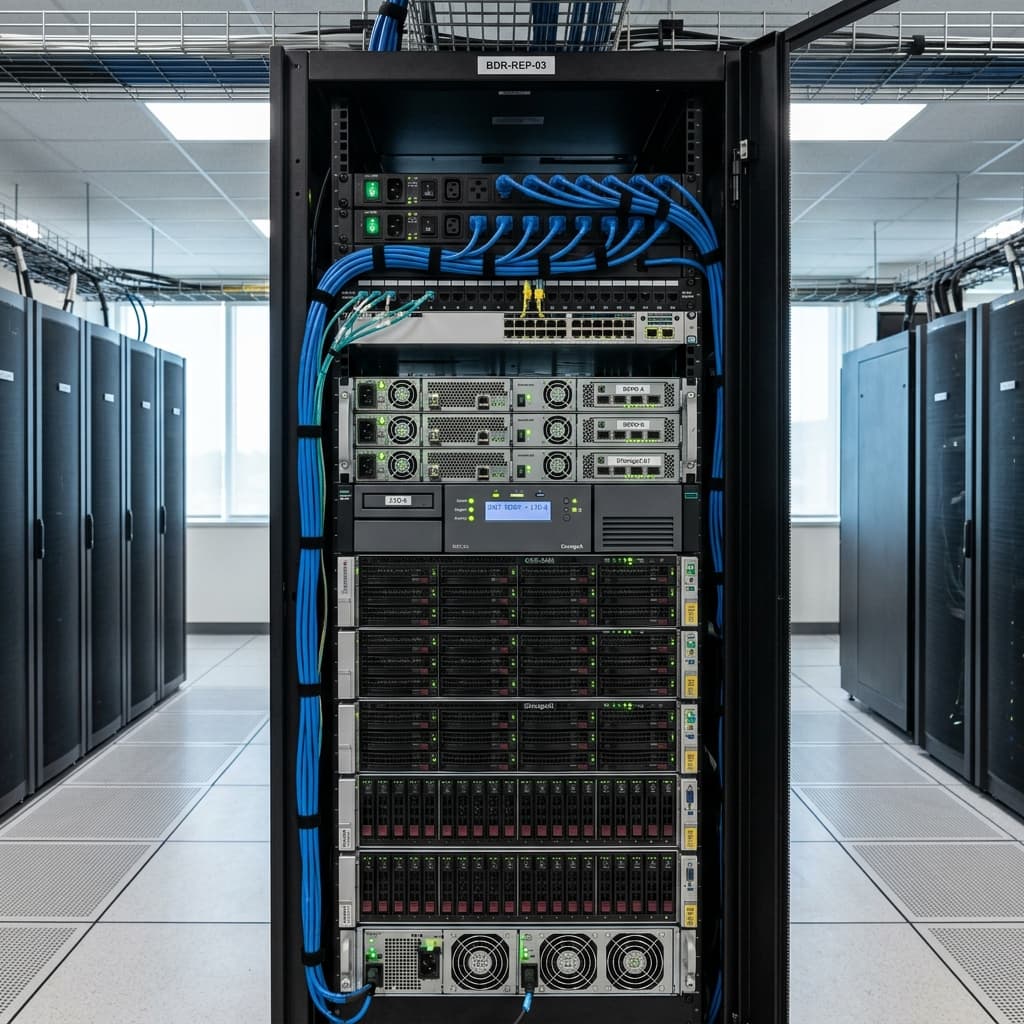
HIGH-CAPACITY BACKUP TARGET
WORM immutable storage repository with 10G/25G uplinks
Defending Enterprise Data Against Outages and Ransomware
Traditional unhardened SMB/NFS network shares leave enterprise backup catalogs directly exposed to malicious encryption and catastrophic data loss.
Targeted Backup Encryption Attacks
Modern ransomware strains explicitly identify and purge online backup catalogs, volume shadow copies, and network shares before executing primary storage encryption.
Unrealistic RTO / RPO Expectations
Procuring storage without modeling recovery time objectives leads to catastrophic outages during restores—where transferring tens of terabytes over slow links exceeds business recovery windows.
Explosive Unstructured Data Growth
Daily data generation outpacing backup windows causes backup jobs to bleed into daytime production hours, degrading core database and virtual machine responsiveness.
Unverified Recovery Readiness
Backups are only as reliable as their last successful restore. Infrequent manual testing leaves corrupt application states, broken database dependencies, and unbootable recovery snapshots undiscovered.
Enterprise Backup & DR Target Platforms
Supplying verified enterprise target platforms from Dell Technologies, Hewlett Packard Enterprise (HPE), Quantum, and certified Linux storage server builders.
Hardened Immutable Backup Repositories
On-premises enterprise storage repositories configured with immutable file system flags (WORM) and S3 Object Lock. Prevents modification, deletion, or premature expiration of backup blocks even if administrative domain credentials are fully compromised.
IDEAL DEPLOYMENT:
Primary on-premises backup repository for virtual machines, database transaction logs, and ransomware-resilient point-in-time retention.
HARDWARE SPECIFICATIONS & CONTROLS:
- Hardened Linux operating environment with single-use administrative credentials and disabled SSH
- Immutable write-once-read-many (WORM) retention enforced at kernel level for defined time windows
- High-density 12–28 drive bays supporting 12Gb/s enterprise SAS drives (up to 400TB+ raw per 2U)
- High-throughput dual 10G/25G SFP28 uplinks for ultra-fast multi-stream ingestion
REPRESENTATIVE HARDWARE:
Dell PowerEdge R760xd2 Storage Server, HPE Alletra 4110/4120 Data Storage Servers
Deduplication Backup Appliances
Specialized target storage appliances utilizing inline variable-length deduplication and high-performance compression. Reduces physical storage requirements by up to 20:1 to 50:1, enabling extended retention on cost-effective footprints.
IDEAL DEPLOYMENT:
Enterprise data centers, multi-site backup consolidation, and high-frequency virtual machine snapshot retention.
HARDWARE SPECIFICATIONS & CONTROLS:
- Hardware-accelerated inline variable-block deduplication minimizing storage footprint
- Data Invulnerability Architecture (DIA) with continuous end-to-end background parity verification
- Network-optimized synthetic full backups avoiding repetitive daily production overhead
- Native encrypted replication to secondary DR data centers with minimal WAN bandwidth utilization
REPRESENTATIVE HARDWARE:
Dell PowerProtect DD (Data Domain) Series (DD6400, DD6900), HPE StoreOnce Systems
Disaster Recovery Replication Infrastructure
Secondary data center hardware clusters configured for continuous or near-synchronous replication. Paired with automated recovery orchestration software to spin up production workloads at an alternate geographical facility in the event of site disaster.
IDEAL DEPLOYMENT:
Mission-critical financial services, high-concurrency ERP platforms, and enterprise business continuity compliance.
HARDWARE SPECIFICATIONS & CONTROLS:
- Sized to mirror production compute and memory allocations for priority-tier applications
- Granular continuous data protection (CDP) reducing RPO from hours to minutes or seconds
- Support for automated runbook orchestration, network IP re-addressing, and non-disruptive failover testing
- Independent power feeds and WAN uplinks isolated from the primary corporate data center
REPRESENTATIVE HARDWARE:
Dell PowerEdge Cluster Targets, NetApp SnapMirror Secondary Arrays, HPE ProLiant Gen11 DR Nodes
Physical Air-Gap & Tape Automation
Linear Tape-Open (LTO) automated tape autoloaders and enterprise modular libraries. Establishes a true physical air gap—completely disconnected from IP networks, power grids, and remote compromise vectors.
IDEAL DEPLOYMENT:
Long-term regulatory archival (7–10+ years), legal hold repositories, and ultimate catastrophic recovery safekeeping.
HARDWARE SPECIFICATIONS & CONTROLS:
- LTO-8 (12TB Native / 30TB Compressed) and LTO-9 (18TB Native / 45TB Compressed) tape cartridges
- Hardware-based AES-256 bit data cartridge encryption and WORM media support
- Automated robotic tape handling with bar code reader for rapid cartridge indexing and offsite transfer
- 30-year archival shelf life for removable media under standard atmospheric storage conditions
REPRESENTATIVE HARDWARE:
HPE StoreEver MSL 1/8 Autoloader & MSL2024/4048 Modular Tape Libraries, Quantum Scalar Series
Backup vs. Replication vs. High Availability vs. Disaster Recovery
Confusing these four distinct infrastructure disciplines frequently results in catastrophic data loss during operational outages.
Point-in-Time Backup
Captures periodic snapshot copies (e.g. hourly, daily) of virtual machines, files, and databases. Designed for granular file retrieval, point-in-time rollback, and compliance archiving.
Continuous Data Replication
Continuously or near-synchronously mirrors storage blocks or virtual machine write streams to a secondary cluster or site. Mitigates data loss between scheduled backup cycles.
High Availability (HA)
Automated hypervisor or clustering failover within the same data center. If a physical host or power supply fails, survivor nodes automatically restart affected virtual machines locally.
Disaster Recovery (DR)
A formalized business continuity framework and secondary facility infrastructure that restores entire computing operations if the primary data center experiences fire, flood, power grid collapse, or total facility outage.
Information Needed for an Accurate Backup Sizing BOM
To formulate an accurate, right-sized Bill of Materials without premature repository saturation, our engineering desk reviews these 6 parameters.
Workload Classification & Tiering
Daily Change Rate & Backup Window Sizing
Retention Period & Deduplication Ratios
Immutability & Access Isolation Strategy
Secondary Site WAN & Bandwidth Calculation
Automated Restore Verification & Sandbox Testing
Backup & Disaster Recovery FAQ
Guidance for IT managers, data protection officers, and business continuity directors.
Does deploying an immutable backup repository guarantee 100% ransomware immunity?
What is the difference between RPO and RTO, and how do they drive hardware sizing?
Can Patel Galaxify Solutions supply hardware for software solutions like Veeam or Commvault?
Why is tape storage still relevant in modern enterprise disaster recovery?
What ongoing maintenance and warranty coverage are supplied with backup repositories?
Complementary Enterprise Solutions
Backup repositories link directly with our enterprise servers, primary storage arrays, and network fabrics.
Enterprise Storage Solutions
SAN, NAS, and All-Flash NVMe primary arrays delivering massive IOPS for transactional databases.
Cybersecurity Infrastructure
Next-Generation Firewalls, network micro-segmentation, and zero-trust perimeter defense.
Hyperconverged Infrastructure
Linearly scalable 3-node and 4-node HCI clusters consolidating compute, storage, and virtualization.
Enterprise Servers & Compute
High-density 1U–4U rack servers engineered for mission-critical virtualization and database workloads.
Fortify Your Enterprise with Immutable Backup Targets
Connect with our storage and data protection specialists to model your daily change rate, select the right immutable repository hardware, and receive competitive RFQ pricing with Pan-India delivery.